Right Plant Right Place – 5 Plants That Passed
First Full Planting Season at Rabbit Run
This was my first full garden season in Kentucky. I had a simple plan: amend the soil, create perfect growing conditions, and trial different color schemes.
What could possibly go wrong?
When I first learned to garden, I assumed that if a plant didn’t perform, it must somehow be my fault. Maybe the soil wasn’t right. Maybe I didn’t water enough. Maybe I planted at the wrong time.
It was never the plant.
That’s the principle behind everything that follows here: plant failure is usually a site-mismatch problem, not a technique problem. Not “what did I do wrong,” but “was this plant ever suited to what I’ve got.” A trial garden isn’t really about finding which plants are good. It’s about finding which plants are good for your specifc site.
Lessons from a Local Kentucky Farm
This spring, a chance visit to a local farm made the principle impossible to ignore. I stopped at Middle Springs Farm in Paris, Kentucky and found myself looking at something rather extraordinary. Thousands of poppies and larkspur growing happily in the fields. No coddling. No drip irrigation. Just plants growing in the native Kentucky soil and looking magnificent.

That poppy field made me think about Beth Chatto’s famouns mantra: “Right Plant, Right Place.” I have said the words often. But I haven’t always practiced what I preach. If I’m honest, there are lots of examples of me trying to make my garden suit the plants.
This was the inspiration for starting the Rabbit Run Trial Garden.
Why Grow a Trail Garden?
I started the Rabbit Run Trial Garden to test which plants would thrive in unamended Kentucky clay, with no irrigation once established, so I could learn what “right place” actually meant before committing to a permanent design at Sugar Hill.
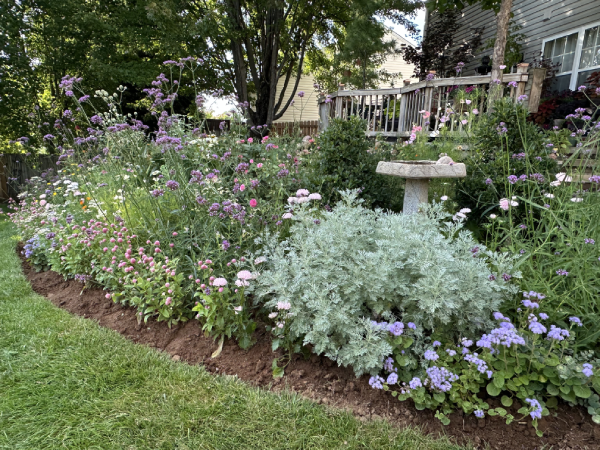
Below are five plants that looked great all season in the trial garden. It’s important to know the site conditions that made them work and I have noted those for reference. The conditions might not transfer to your specific garden conditions.
These plants may perform differently in your garden if your soil, sun, or moisture levels don’t match the conditions in my trail garden. The baseline conditions at Rabbit Run include well-draining soil, full sun, and supplemental irrigation while seedlings and new plants got established. Plants were spaced close together, which left little exposed soil and kept weed pressure low. Rain carried the garden through May, June and July. August and early September turned hot and dry which means I have brought out the garden hose to keep things watered.
The Keepers
1. Ilex ‘Magland’ (Oakland Holly)
Every good garden needs structure. The focus at Rabbit Run isn’t elaborate garden bones, but I want something to look at when the flowers finish and winter takes hold.
Last season I bought several Oakland hollies from Home Depot for the surprisingly reasonable $34.40 each. They’ve been growing like champs in full sun and well-draining soil, with irrigation only while they were getting established, providing a quiet backdrop to the border now. These will eventually come with me to Sugar Hill, where I expect they’ll help enclose a garden room. I like plants willing to work for their keep in more than one garden.
Site Conditions for Success: Full sun, well-draining soil. Needed water only through establishment — holding up through the current hot, dry stretch without supplemental irrigation.

2. Euphorbia x martinii ‘Ascot Rainbow’ (PP21401)
If I had to choose one plant to best demonstrate what I’m looking for in a low-maintenance garden, it would be this one. It has season-long interest, starting in spring when it’s covered with tiny flower bracts with brightly colored eyes, and foliage that stays interesting all season — greenish-blue leaves edged in creamy yellow.
This plant that doesn’t demand much attention, but looks interesting always. Grown in full sun and well-draining soil, it need water only to get established. Now that I know this plant performs, it’s a keeper. I’m adding four more this autumn to build a buttery-yellow-and-white color scheme.
Site Conditions for Success: Full sun, well-draining soil. Drought-tolerant enough to hold up through August without hose irrigation, once established. I take care to avoid over watering if I am watering plants close by.

3. Gomphrena globosa ‘Salmon Pastel’
This plant taught me something. I sowed seed on February 24. By May 25, it was blooming in the garden. But there was a brief period when I thought this plant wouldn’t make it. The leaves of the seedlings started turning a deep purple after they were planted into the garden. My first thought was that it didn’t like the clay soil.
The actual problem was that I was that I planted the gomphrena into the garden before soil temperatures reached 50°F. Cold soil temperatures prevents the plant from absorbing phosphorous from the soil. Once the soil warmed, the leaves greened right up and kept blooming. It is September 4th and they are still going strong.
Site Conditions for Success: Tolerates clay soil well once soil temperature is above 50°F at planting. Cold clay before that threshold shows up as purple foliage from phosphorus lockout — not a soil-quality problem, a timing problem.

4. Ageratum Mexicanum Blue
Another all-season performer that started life under my grow lights. I sowed seed on February 4. Germination was poor, but the plants that did grow surprised me by blooming while they were still under the lights.
Once transplanted, they went into full sun and well-draining soil. I watered until the seedlings were established. They proved quite drought tolerant once established. My only regret is not planting enough. I will be adding more Ageratum at Rabbit Run next season.
Site Conditions for Success: Full sun, well-draining soil, drought tolerant once established. Take care not to over water.

5. Sedum spectabile ‘Autumn Fire’
I bought two small sedums from Lowe’s last autumn, expecting ‘Autumn Joy’. When I got home I realized the plant tag confirmed the variety I purchased was ‘Autumn Fire’, a variety less prone to flopping.
I’ve never had luck growing sedum in my Michigan garden. I never had enough sun and the plants inevitably flopped. This time, the claim held up. The stems of this variety “Autumn Fire’ are remarkably sturdy. The two small plants have turned into two enormous clumps. This autumn I’ll divide them into repeating groups along the border.
Site Conditions for Success: Full sun, well-drained soil. Take care not to over water this plant. It is drought tolerant once established. It hasn’t required supplemental water at Rabbit Run. If anything, I need to take care to ensure this plant doesn’t receive too much water when I irrigate some of the surrounding plants.

Overall Assessment of the Season
None of the five plants above are guaranteed to succeed. They are a starting point. Before matching anything from this list to your own garden, it’s worth understanding your site the way I am understanding mine.
How many hours of direct sum does your site receive? How well does your soil drain? What type of moisture conditions does your site see? Does the season receive steady rain, or are there periods that are hot and dry.
A plant that only proves itself in May and June may not be suited to survive throughout the entire growing season. The plants that are resilient are the ones that survive your site with minimal input. These are what I call “The Keepers“.